Why AI Assistants Are Becoming More Personal
For years, digital assistants were mostly reactive.
You asked a question.
They gave you an answer.
You asked for the weather.
They told you the forecast.
You asked for a reminder.
They created one.
Useful, but limited.
The newer generation of AI assistants is aiming for something very different.
Instead of simply waiting for instructions, they are increasingly designed to understand context, work across multiple tasks and help people accomplish larger goals.
That shift could change what we expect from software.
Because the future of AI may not be about having a smarter search box.
It may be about having something that feels more like a personal digital layer around your everyday life.
From Commands to Conversations
Older digital assistants were built around commands.
You had to phrase your request in a way the system understood.
AI changed that interaction.
You can now explain what you want in ordinary language.
You don’t necessarily need to know the exact command.
You can describe a problem.
Ask a follow-up.
Change your mind.
Add another requirement.
The system can maintain more of the conversation and respond based on the context.
That sounds like a small improvement.
It isn’t.
It changes the relationship between people and software.
Software Used to Make You Learn the System
Think about traditional software.
You open an application.
You see menus.
Buttons.
Settings.
Options.
You learn where everything is.
Over time, you become better at using the software.
AI reverses part of that relationship.
Instead of you learning every feature, you can increasingly explain what you want and let the system figure out which capabilities are needed.
The interface becomes less about where the button is and more about what you want to accomplish.
That’s a major shift in software design.
The Personal Part Is Context
A truly useful assistant needs context.
Imagine asking:
“Help me prepare for tomorrow.”
That request is almost meaningless without knowing what tomorrow contains.
Do you have a meeting?
A flight?
An exam?
A presentation?
A deadline?
The more context an assistant has, the more useful it can potentially become.
But context also creates difficult questions about privacy, permissions and control.
The more an AI system knows about your digital life, the more carefully that information needs to be handled.
AI Doesn’t Just Have to Answer
One of the biggest changes happening in AI is the movement from answers to actions.
An assistant that tells you how to organize a project is useful.
An assistant that can help organize the project is potentially much more useful.
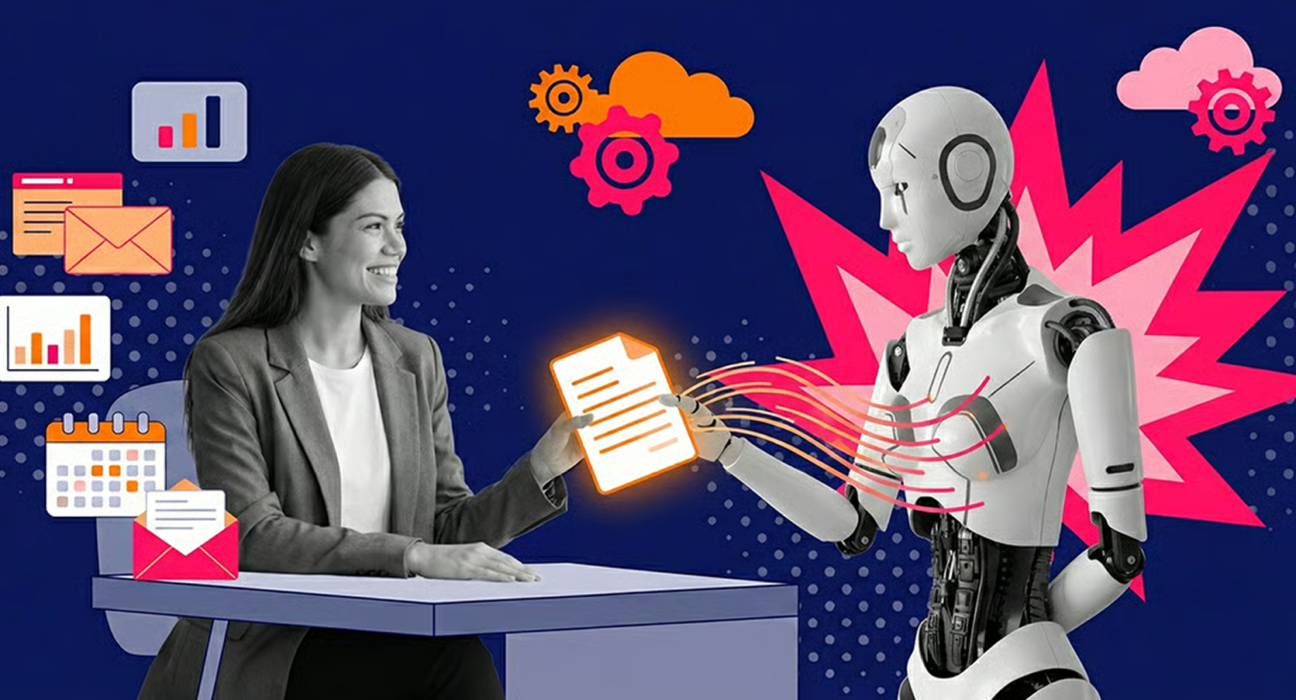
That could mean working with documents, analyzing information, preparing drafts, coordinating tasks or helping move information between different tools.
The distinction is important.
A chatbot primarily produces responses.
A more capable AI agent can potentially help complete a workflow.
The End of “One App for One Job”?
Modern digital life is fragmented.
You might use one application for email.
Another for documents.
Another for project management.
Another for messaging.
Another for calendars.
Another for research.
Another for finance.
Another for shopping.
Humans move between these systems constantly.
AI assistants could become a layer connecting them.
Instead of opening five applications and manually transferring information between them, you could describe the outcome you want.
The assistant could potentially coordinate the steps.
That doesn’t mean every task will become fully automated.
But the direction is clear:
software is becoming more conversational and increasingly task-oriented.
Why Personalization Matters
Two people can ask the same question and need completely different answers.
Consider:
“Help me plan a trip.”
A student may care about price.
A business traveler may care about time.
A family may care about convenience.
A photographer may care about locations.
A frequent traveler may want something completely different.
A personalized assistant can potentially use known preferences and context to produce a more relevant result.
The challenge is making personalization useful without becoming intrusive.
The Assistant Could Learn Your Patterns
Imagine an AI that understands that you prefer short meetings in the morning.
Or that you usually prepare presentations several days before a deadline.
Or that you prefer certain types of travel.
Or that you like receiving information in a particular format.
The assistant doesn’t necessarily need to ask the same questions every time.
It can use established preferences to reduce repetitive work.
That is where AI starts to feel genuinely personal.
The value isn’t simply intelligence.
It’s continuity.
But Personalization Has a Price
The more personalized an assistant becomes, the more information it may need.
That creates an uncomfortable trade-off.
People want technology that understands them.
But they don’t necessarily want technology that knows everything about them.
A useful AI assistant therefore needs clear boundaries.
Users should understand:
- What information is being used
- Why it is being used
- What the assistant can access
- What actions it can take
- What can be changed or revoked
Convenience should not require giving up control.
The New Interface Might Be Almost Invisible
For decades, software design focused heavily on screens.
Buttons.
Menus.
Dashboards.
Navigation.
AI introduces another possibility.
You may simply tell the system what you need.
The assistant determines the steps.
The interface becomes less visible.
That doesn’t mean screens disappear.
It means the user may spend less time navigating them manually.
The software becomes something you communicate with rather than something you operate step by step.
AI Could Change How We Search
Search engines traditionally work like this:
Question → results → evaluation → action
AI assistants can potentially compress that process.
Question → synthesized answer → next action
Instead of opening ten pages, comparing information and deciding what matters, users may increasingly expect software to do more of the interpretation.
That could save enormous amounts of time.
It could also create a new problem:
How do you know whether the assistant is right?
The easier information becomes to consume, the more important verification can become.
The Best Assistant May Be the One You Barely Notice
The most useful AI may not constantly announce that it is intelligent.
It may simply remove small frustrations.
Summarizing a long document.
Finding information.
Organizing tasks.
Preparing a draft.
Explaining something complicated.
Remembering a preference.
Helping with repetitive work.
The individual improvements may seem small.
Together, they can change how a person spends their day.
AI Is Moving From Tool to Layer
A traditional tool is something you open when you need it.
An AI assistant can potentially become something that sits across many parts of your digital life.
It can help with work.
Learning.
Planning.
Communication.
Research.
Creativity.
Organization.
That makes AI less like another application and more like a layer connecting different applications.
This may be one of the most important changes in personal computing.
The Real Competition May Be for Context
As AI models become increasingly capable, raw intelligence may no longer be the only differentiator.
Different systems may eventually be able to answer similar questions reasonably well.
The bigger difference could become:
Who understands your context best?
Who knows what you’re working on?
Who understands your preferences?
Who can access the tools you actually use?
Who can help complete the task rather than simply explain it?
That is where personal AI could become extremely valuable.
The Human Still Has to Be in Control
There is one important limit.
An assistant can help you make decisions.
It shouldn’t automatically become the decision-maker for everything.
There are tasks where human judgment matters.
There are situations where mistakes can be expensive.
There are actions that should require confirmation.
The more powerful AI becomes, the more important these boundaries become.
The ideal assistant isn’t one that controls your digital life.
It’s one that gives you more control over your time.
The Next Generation of Assistants Will Feel Different
The most interesting development in AI isn’t simply that models can write better answers.
It’s that software is gradually becoming more capable of understanding what people are trying to accomplish.
That changes the fundamental interaction.
Instead of:
“Which button should I press?”
The question becomes:
“What do I want to get done?”
And if AI can reliably bridge the gap between those two things, the assistant of the future may feel less like a chatbot and more like a quiet digital partner working in the background.
The technology is still evolving.
The privacy questions aren’t solved.
The reliability isn’t perfect.
But the direction is difficult to ignore.
AI is becoming less about talking to a machine — and more about having software that understands what you’re trying to do.