How Do AI Chatbots Work? A Simple Guide to AI Conversations
AI chatbots have quickly become part of everyday digital life.
People now use them to answer questions, summarize documents, write emails, generate ideas, translate text, learn new subjects, analyze information, and assist with many different tasks.
But when you type a question into an AI chatbot and receive an answer within seconds, what is actually happening behind the screen?
The technology behind modern AI chatbots is considerably more complex than a traditional search box or scripted customer-service bot.
At the center of many modern AI chatbots is a type of artificial intelligence model called a large language model, or LLM.
Understanding how these systems work can help explain both what AI chatbots are capable of and why they sometimes make mistakes.
What Is an AI Chatbot?
An AI chatbot is a software system that can interact with users through natural language.
Instead of requiring users to select predefined buttons or commands, an AI chatbot can process written prompts and generate responses.
Depending on the system, it may be able to:
- Answer questions
- Explain concepts
- Write and edit text
- Summarize information
- Translate languages
- Generate code
- Analyze documents
- Brainstorm ideas
- Help with research
- Create structured content
Traditional chatbots often rely on predefined rules and responses.
Modern AI chatbots can generate responses dynamically based on the conversation and the instructions they receive.
What Is a Large Language Model?
A large language model is an AI system trained to process and generate language.
It learns statistical patterns from large collections of text and other training data.
Rather than storing a simple list of answers to every possible question, the model learns relationships between words, phrases, concepts, and patterns.
This allows it to generate new responses based on the input it receives.
Large language models are the underlying technology behind many modern AI assistants and chatbots.
How Does an AI Chatbot Understand a Question?
When you type something into an AI chatbot, the system doesn’t understand the sentence exactly like a human does.
The text is processed into smaller units called tokens.
A token can represent:
- A complete word
- Part of a word
- Punctuation
- Other pieces of text
For example, a sentence may be divided into several tokens before being processed by the model.
The model then analyzes the relationships between these tokens and the surrounding context.
This allows it to determine what kind of response is likely to be appropriate.
What Happens After You Send a Prompt?
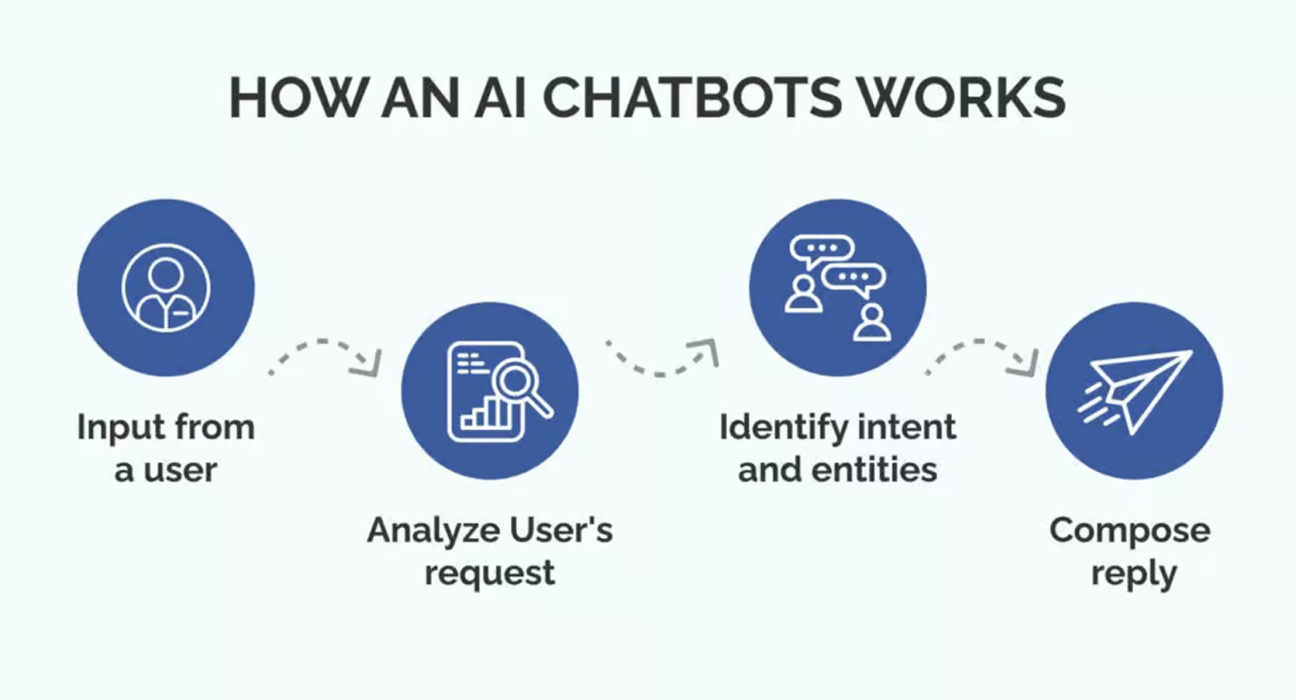
A simplified version of the process looks like this:
Your prompt → Tokenization → Model processing → Token prediction → Generated response
Let’s break that down.
Step 1: You provide a prompt
You might type:
“Explain how solar panels work.”
The system receives your text as input.
Step 2: The text is tokenized
The sentence is converted into tokens that the model can process.
Step 3: The model analyzes the context
The model examines the tokens and their relationships.
It considers the wording, context, instructions, and other information available within the conversation.
Step 4: The model predicts the next tokens
The model generates a response one token at a time.
It estimates which token is most appropriate to follow the previous information.
Step 5: The response is assembled
The generated tokens are converted back into readable text and displayed to you.
All of this can happen very quickly.
Does an AI Chatbot Search the Internet for Every Answer?
No.
An AI chatbot does not automatically search the internet every time it responds.
Some AI systems can access web search or other external tools when those capabilities are available and enabled.
Without such tools, the model generally generates its response using information and patterns learned during training, along with the context provided in the conversation.
This distinction is important.
A model can produce a confident answer without having checked a current website.
That means questions involving rapidly changing information—such as current prices, breaking news, live sports results, or recent events—may require access to up-to-date sources.
How Does an AI Model Learn?
Before an AI chatbot can respond to users, its underlying model goes through training.
During training, the model processes very large amounts of data.
The goal is to learn patterns in the data.
For language models, these patterns can include relationships between:
- Words
- Sentences
- Concepts
- Writing styles
- Languages
- Topics
- Context
The model contains a very large number of adjustable numerical values called parameters.
Training adjusts these parameters so the model becomes better at predicting and generating appropriate sequences of tokens.
What Are Parameters?
Parameters are numerical values inside a machine-learning model that are adjusted during training.
They help determine how the model processes information and generates predictions.
Modern language models can contain enormous numbers of parameters.
However, parameter count alone does not determine whether one AI model is better than another.
Architecture, training data, training methods, reasoning capabilities, tools, optimization, and other factors also matter.
Why Can AI Chatbots Write Like Humans?
Language models are trained on huge amounts of human-created language.
During training, they learn patterns in how people communicate.
They can learn that certain words frequently appear together, that particular structures are common in specific types of writing, and that different contexts require different styles.
For example, a professional email may have a very different structure from a technical explanation or a fictional story.
The model can use these learned patterns to generate text that appears natural to humans.
This doesn’t mean the AI has human experiences or consciousness.
It means the model has become highly capable at processing and generating language.
Do AI Chatbots Actually Understand What They Say?
This is a complicated question.
AI models can demonstrate impressive abilities in language, reasoning, coding, and other tasks.
However, their internal processing is fundamentally different from human understanding.
A language model does not experience the world in the same way a person does.
It doesn’t have human senses, personal experiences, or emotions simply because it can discuss those concepts.
It generates outputs based on learned patterns, instructions, context, and its underlying computational processes.
Why Do AI Chatbots Sometimes Make Mistakes?
One of the most important limitations of AI chatbots is that they can generate incorrect information.
Sometimes the response may sound extremely confident even when the information is wrong.
This phenomenon is commonly referred to as an AI hallucination.
For example, a model might:
- Invent a source
- Misstate a fact
- Give an incorrect calculation
- Confuse two people or events
- Provide an outdated answer
- Attribute a quote incorrectly
- Generate a nonexistent reference
This happens because language models are designed to generate plausible sequences of tokens, not simply retrieve verified facts from a database.
Why Confidence Does Not Mean Accuracy
Humans often associate confident language with knowledge.
AI systems can produce confident language even when they are uncertain or incorrect.
Consider two answers:
“I believe the answer may be X.”
and
“The answer is definitely X.”
The second sounds more authoritative.
But the wording itself does not guarantee that the underlying information is correct.
This is why important information should be verified using reliable sources.
What Is Context in an AI Conversation?
Context is the information available to the model while generating a response.
For example, if you first say:
“I’m planning a trip to Japan.”
and later ask:
“What should I pack?”
the earlier statement provides useful context.
The model can use information from the conversation to make the response more relevant.
The amount of context an AI system can process depends on its architecture and context-window capabilities.
What Is a Context Window?
A context window is the amount of information a model can consider within a particular interaction.
It can include:
- Your current prompt
- Previous messages
- System instructions
- Other provided information
- Tool results
- Uploaded content, depending on the system
Larger context windows allow models to work with more information at once.
This can be especially useful when analyzing long documents, large conversations, or complex instructions.
How Do AI Chatbots Generate Different Answers?
Ask an AI chatbot the same question multiple times and you may sometimes receive different wording or even different approaches.
This can happen because generation can involve probabilistic sampling.
The system does not always have to select exactly the same sequence of tokens.
Settings and model behavior can influence how deterministic or varied responses are.
This is one reason AI-generated content can differ between requests.
What Is Temperature in AI?
Temperature is a parameter used in some language-model systems to influence the randomness of token selection.
A lower temperature generally makes outputs more predictable.
A higher temperature can encourage greater variation.
The exact behavior depends on the model and implementation.
For tasks requiring consistent and precise output, lower variability can be useful.
For brainstorming and creative writing, more variation can sometimes be desirable.
How Do AI Chatbots Follow Instructions?
Modern AI systems can process instructions alongside user prompts.
For example, a user might ask:
“Explain quantum computing in simple language.”
The model doesn’t simply identify the topic “quantum computing.”
It also needs to follow the instruction to explain it simply.
This ability to follow instructions is an important part of modern AI assistants.
Systems can also be designed with additional instructions that influence behavior, formatting, safety, tool use, or other requirements.
Can AI Chatbots Remember Previous Conversations?
This depends on the particular AI product.
Some systems can maintain context within a conversation.
Some products also offer memory features that allow certain information to be retained across conversations.
Other systems may not retain information after a conversation ends.
Therefore, “AI memory” is not one universal capability.
It depends on how the specific product is designed and configured.
How Do AI Chatbots Generate Code?
Language models can also work with programming languages.
During training, models can learn patterns from code and technical documentation.
When a user asks for a program, the model generates code based on:
- The programming language
- User requirements
- Existing context
- Patterns learned during training
For example, a user might ask for a Python script to process a spreadsheet.
The model can generate code that attempts to perform the requested task.
However, generated code should still be tested.
A program can look correct while containing bugs, security problems, or incorrect assumptions.
Can AI Chatbots Analyze Images?
Some modern AI systems can process images in addition to text.
Depending on the system, users may be able to upload:
- Photographs
- Screenshots
- Charts
- Documents
- Diagrams
- Design mockups
The AI can then analyze visual information alongside textual instructions.
This creates a multimodal interaction rather than a purely text-based conversation.
What Is Multimodal AI?
Multimodal AI refers to systems capable of processing or generating multiple types of information.
These may include:
- Text
- Images
- Audio
- Video
- Code
Instead of treating each type of information as completely separate, multimodal systems can combine different inputs.
For example, a user might upload a chart and ask the AI to explain the trend shown in it.
How Do AI Chatbots Improve Over Time?
AI systems can improve through several processes.
Developers may:
- Train newer models
- Improve training data
- Refine model architectures
- Improve instruction-following
- Add external tools
- Improve safety systems
- Improve reasoning capabilities
- Fix known problems
However, an AI chatbot does not necessarily “learn” from every individual conversation in real time.
The exact learning and improvement process depends on the product and how its developers operate it.
Are AI Chatbots Replacing Search Engines?
AI chatbots and search engines serve overlapping but different purposes.
A traditional search engine primarily helps users find information and websites.
An AI chatbot can generate a conversational response based on the information available to it.
For example:
Search engine:
Provides links and search results.
AI chatbot:
Can explain a concept, summarize information, or help transform a request into a structured answer.
Modern search engines are also incorporating AI features, while AI assistants can sometimes use search tools.
The distinction between the two is therefore becoming less rigid.
When Should You Verify an AI Answer?
Verification is particularly important when the information could have significant consequences.
You should consider checking reliable sources when dealing with:
- Financial decisions
- Medical information
- Legal matters
- Current events
- Current prices
- Statistics
- Academic research
- Technical specifications
- Business decisions
An AI-generated answer can be useful as a starting point, but it should not automatically be treated as authoritative.
How to Get Better Answers From an AI Chatbot
The quality of your prompt can make a significant difference.
Instead of asking:
“Tell me about laptops.”
you could ask:
“Compare the most important factors to consider when buying a laptop for video editing, including CPU, GPU, RAM, storage, display, and battery life.”
The second prompt provides more context and a clearer objective.
Useful prompting techniques include:
- Clearly state your goal
- Provide relevant context
- Specify the desired format
- Mention important constraints
- Give examples when useful
- Ask the model to explain assumptions
- Request sources when appropriate
The Future of AI Chatbots
AI chatbots are evolving beyond simple text conversations.
Future systems are likely to become increasingly capable of working across multiple types of information and interacting with software and external tools.
They may assist with:
- Research
- Education
- Software development
- Business operations
- Customer service
- Creative work
- Data analysis
- Personal productivity
The important question will not simply be how much AI can generate.
It will also be how reliably it can reason, verify information, use tools, understand context, and assist humans with real-world tasks.
Final Thoughts
AI chatbots may appear simple from the user’s perspective: type a question, press enter, and receive an answer.
Behind that interaction is a complex combination of machine learning, language processing, neural networks, token prediction, computing infrastructure, and software systems.
Large language models learn patterns from enormous amounts of training data and use those patterns to generate responses based on the input and context they receive.
But they are not infallible.
They can produce incorrect information, misunderstand instructions, or generate convincing answers that are not supported by reliable evidence.
The best way to use AI chatbots is therefore not to treat them as an unquestionable source of truth, but as powerful tools that can help you think, create, analyze, learn, and work more efficiently.