How Do Movie Ratings Work? A Simple Guide to Film Classifications
Have you ever looked at a movie and wondered what PG-13, R, 12A, or another rating actually means?
Movie ratings are designed to give audiences information about the content of a film before they watch it.
They can help parents decide whether a movie is suitable for children, help viewers understand the type of content they may encounter, and provide theaters, broadcasters, and streaming platforms with guidance about audiences.
However, movie ratings aren’t universal.
Different countries have different classification systems, terminology, and rules. A film that receives one rating in the United States may receive a completely different classification in the United Kingdom, India, Australia, or another country.
So how does the process actually work?
What Is a Movie Rating?
A movie rating or classification is an age-related or content-related designation assigned to a film.
The purpose is generally to communicate whether a movie contains material that may not be suitable for certain age groups.
Depending on the classification system, reviewers may consider factors such as:
- Violence
- Language
- Sexual content
- Nudity
- Drug use
- Horror
- Threat
- Disturbing themes
- Discrimination
- Dangerous behavior
The exact criteria vary between countries.
Why Do Movies Need Ratings?
Movies are created for different audiences.
A light animated film intended for young children may have very different content from a violent action movie or an adult drama.
A rating gives viewers a quick indication of what to expect.
For parents, this can be particularly useful.
Instead of watching an entire movie first, they can check its classification and content information before deciding whether it is appropriate for their children.
Ratings can also help adults make informed choices about films containing themes they may prefer to avoid.
How Are Movies Rated?
The process differs depending on the country and classification organization.
Generally, a film is submitted for classification and evaluated according to established guidelines.
Reviewers may watch the film and assess elements such as:
- Overall theme
- Violence
- Language
- Sexual material
- Nudity
- Drug references
- Horror
- Threat
- Context
- Frequency of certain material
- Intensity of the content
The final classification is based on the rules used by that particular system.
Are Movie Ratings the Same Everywhere?
No.
This is one of the most important things to understand about film classifications.
A movie does not have one universal global rating.
Different countries have their own systems.
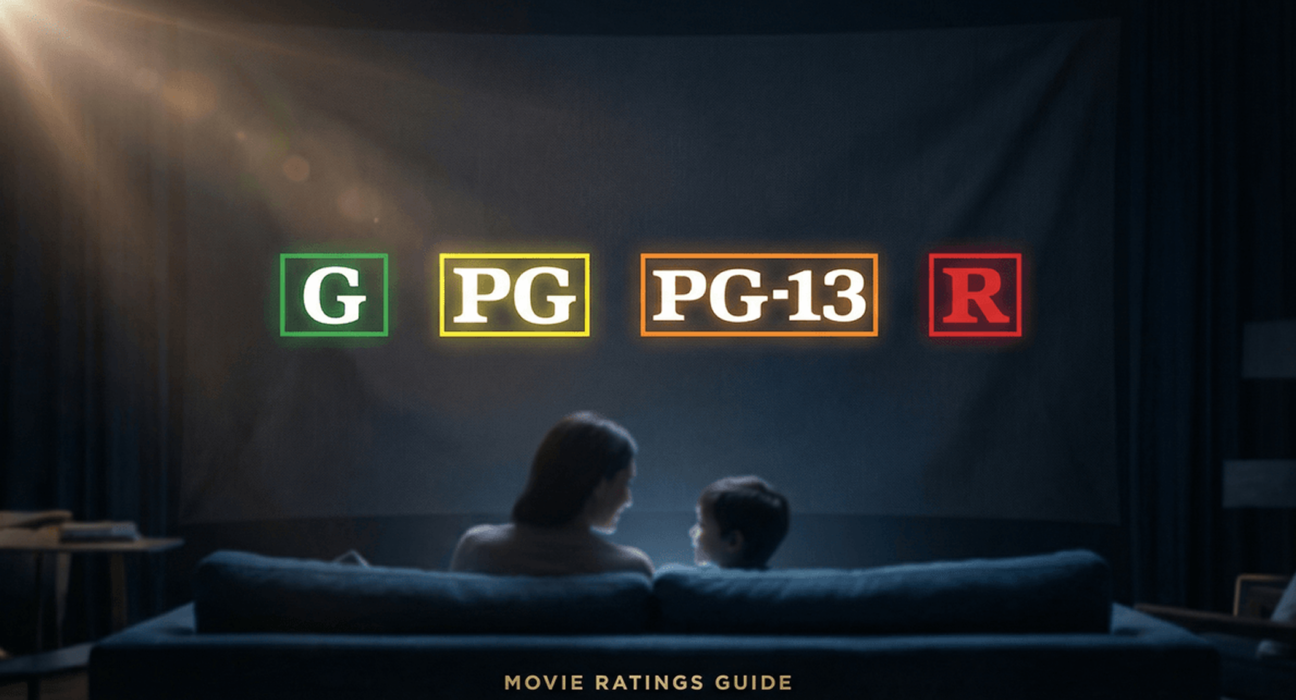
For example, the United States uses classifications such as:
- G
- PG
- PG-13
- R
- NC-17
The United Kingdom uses classifications such as:
- U
- PG
- 12A
- 12
- 15
- 18
- R18
Other countries use their own systems.
This means the same movie can receive different classifications depending on where it is released.
Understanding Common U.S. Movie Ratings
The U.S. system operated by the Motion Picture Association uses several familiar classifications.
G — General Audiences
A G rating indicates that the film is considered suitable for general audiences.
It generally contains little or no material that would be inappropriate for young children.
However, parents can still decide whether a particular movie is suitable for their individual child.
PG — Parental Guidance Suggested
PG indicates that some material may not be suitable for young children.
Parents are encouraged to consider whether the content is appropriate for their children.
A PG movie might contain mild language, thematic material, action, or other elements that parents may want to know about.
PG-13 — Parents Strongly Cautioned
PG-13 indicates that some material may be inappropriate for children under 13.
Parents are strongly encouraged to consider the content before allowing younger children to watch.
PG-13 movies can contain stronger language, violence, mature themes, or other content than a typical PG film.
R — Restricted
An R rating indicates that the film contains material considered unsuitable for younger audiences.
Children under a specified age may require accompaniment by a parent or adult guardian, depending on the applicable rules.
R-rated movies can include stronger:
- Violence
- Language
- Sexual content
- Drug use
- Mature themes
The specific reasons for the rating can vary from movie to movie.
NC-17
NC-17 indicates that the film is intended for adult audiences.
People below the specified age are not admitted.
The classification does not necessarily mean that a film is illegal or inherently inappropriate for every adult. It indicates that the content has been classified as suitable only for adults under that system.
How the UK Rating System Works
The United Kingdom uses a different classification structure.
The British Board of Film Classification, commonly known as the BBFC, provides classifications for films and certain other content.
Common categories include:
U — Universal
A U classification indicates that the content is considered suitable for audiences generally.
It is primarily associated with material suitable for young children.
PG — Parental Guidance
A PG classification indicates that the content is generally suitable for children, but some scenes may require parental consideration.
12A
A 12A classification is used for cinema releases.
Children younger than 12 can watch a 12A film when accompanied by an adult.
The adult is responsible for deciding whether the content is appropriate.
12
A 12 classification is used for certain releases such as home entertainment.
Only people aged 12 or older may generally access content carrying this classification.
15
A 15 classification means the content is intended for people aged 15 and over.
18
An 18 classification means the content is intended for adults.
These categories demonstrate why movie ratings can look very different when you travel between countries.
How Movie Ratings Work in India
India has its own film certification system.
Films released theatrically in India are certified by the Central Board of Film Certification (CBFC).
Common certification categories include:
- U
- UA
- A
- S
The categories communicate different levels or types of audience suitability.
The Indian classification system has also evolved over time, including changes to the way age-based guidance is communicated.
For Indian audiences, it is therefore useful to check the certification attached to the particular release rather than assuming that an international rating automatically applies.
What Factors Affect a Movie Rating?
A movie’s rating can depend on much more than one individual scene.
Classification organizations may consider the overall context of the material.
Violence
Violence is one of the most common factors considered during classification.
Reviewers may consider:
- How graphic the violence is
- How frequently it occurs
- Whether injuries are shown
- Whether weapons are involved
- Whether the violence is realistic
- Whether the violence is presented as humorous or serious
A brief action scene may be treated differently from prolonged graphic violence.
Language
The amount and strength of language can influence a film’s classification.
Reviewers may consider:
- Frequency
- Context
- Severity
- Whether particularly strong terms are used
A single word may be treated differently from repeated or aggressive use of strong language.
Sexual Content
Sexual references, sexual activity, nudity, and related material can affect classification.
Again, context matters.
A brief reference may receive different treatment from explicit sexual content.
Drugs and Alcohol
Depictions or references involving drugs and alcohol may also be considered.
Classification can depend on:
- What substances are shown
- How they are portrayed
- Whether use is encouraged
- How frequently the material appears
- Whether the content is educational, dramatic, or celebratory
Horror and Threat
Horror movies demonstrate why classification isn’t based solely on explicit violence.
A film may contain relatively little blood but still be disturbing because of:
- Psychological tension
- Threat
- Frightening imagery
- Jump scares
- Intense atmosphere
- Disturbing themes
The overall effect of the material can therefore matter.
Why Context Matters
The same action can have different effects depending on how it is presented.
For example, a character saying something inappropriate in a comedy may be treated differently from the same language being used aggressively in a serious drama.
Similarly, violence in a fantasy film may be evaluated differently from realistic violence depicting serious injury.
Classification systems therefore look at context rather than simply counting individual words or scenes.
Why Do Movies Sometimes Get Different Ratings After Editing?
A movie can sometimes receive a different classification after changes are made.
For example, filmmakers or distributors may edit:
- Language
- Violence
- Sexual material
- Drug references
- Graphic imagery
- Specific scenes
An edited version can therefore receive a different classification from an original version.
This can happen when a distributor wants a film to reach a broader audience.
Why Do Ratings Differ Between Countries?
Different countries have different cultural expectations and classification standards.
Something considered acceptable for a particular age group in one country may be treated differently elsewhere.
Legal requirements also vary.
As a result, a film might receive:
PG-13 in one country
while receiving:
15 in another
This doesn’t necessarily mean one classification system is more accurate.
It reflects differences in classification guidelines and cultural context.
Do Movie Ratings Tell You Whether a Movie Is Good?
No.
A rating tells you about content and audience suitability, not whether a movie is good.
A critically acclaimed drama might receive a mature classification.
A poorly reviewed movie might receive a family-friendly classification.
Similarly, a film rated for adults isn’t necessarily better or worse than a movie suitable for children.
The rating answers a different question:
“Who is this content considered suitable for?”
It does not answer:
“Is this movie worth watching?”
Movie Rating vs Review Score
These are two completely different things.
Classification
A classification tells you about age suitability and content.
Examples:
- PG
- PG-13
- 15
- 18
Review score
A review score evaluates the quality or appeal of a movie.
Examples might include:
- 4/5 stars
- 8/10
- 90%
- 7.5/10
A movie can have an adult classification and receive excellent reviews.
Another movie can be suitable for children and receive poor reviews.
Don’t confuse the two.
How to Check a Movie’s Rating
Before watching a movie, you can usually find its classification through:
- The movie’s official website
- Cinema listings
- Streaming services
- Film databases
- Classification organization websites
- Local theater listings
Streaming platforms often provide additional content descriptions.
For example, instead of simply showing an age rating, a service may also mention:
Violence, language, sexual content, or substance use.
This additional information can be more useful than the rating alone.
Are Streaming Services Rated the Same Way?
Not necessarily.
Streaming platforms operate across multiple countries and may display different classifications depending on the viewer’s location.
A movie can therefore show different age guidance to viewers in different countries.
Streaming services may also provide their own content descriptors alongside official or locally applicable classifications.
This makes it easier for viewers to understand why a particular title received its rating.
How Parents Can Use Movie Ratings
Parents can use classifications as a starting point rather than treating them as an absolute answer.
Before allowing a child to watch a movie, consider:
- The official rating
- The reasons given for the rating
- The child’s age
- The child’s maturity level
- The themes in the movie
- Whether the child is sensitive to frightening or disturbing material
Two children of the same age can react very differently to the same movie.
A classification provides general guidance, while parents ultimately know their children best.
Are Movie Ratings Perfect?
No classification system can predict exactly how every viewer will respond to a film.
Ratings are designed as guidance.
A movie that is perfectly comfortable for one viewer may be disturbing to another.
This is particularly relevant for:
- Horror
- Psychological thrillers
- Movies involving grief
- War films
- Disaster stories
- Real-world tragedies
In these cases, reading the content description can be more useful than looking at the age rating alone.
Final Thoughts
Movie ratings are designed to make it easier for audiences to understand the type of content they may encounter before watching a film.
However, there is no single global rating system.
Different countries use different classifications, and the same movie can receive different ratings depending on where it is released.
Ratings can consider violence, language, sexual content, nudity, drugs, horror, themes, and the overall context in which these elements appear.
The most useful approach is to treat a movie rating as guidance rather than a review.
It can tell you whether a movie may be suitable for a particular audience, but it cannot tell you whether you will enjoy it.
For that, you’ll still need to watch the movie—or read a good review first.