How Do Satellites Work? A Simple Guide to Satellite Technology
Satellites are an important part of modern life, even though most people rarely think about them.
They help provide GPS navigation, weather forecasts, television services, internet connectivity, scientific data and communication across large distances.
Some satellites observe Earth, while others study space. Some are designed to communicate with devices on the ground, while others collect scientific measurements.
But how do these machines stay in space, and how do they actually work?
Let’s take a simple look at satellite technology.
What Is a Satellite?
A satellite is an object that moves around another object in space.
There are two broad types:
Natural satellites are objects that occur naturally, such as the Moon orbiting Earth.
Artificial satellites are machines built and launched by humans.
When people talk about satellites in technology and communications, they are usually referring to artificial satellites.
These spacecraft are placed into specific orbits around Earth or other celestial bodies.
What Does a Satellite Do?
A satellite’s job depends on its mission.
Some common purposes include:
- Communication
- Navigation
- Weather monitoring
- Earth observation
- Scientific research
- Environmental monitoring
- Space observation
- Defense and security
A satellite may perform one primary function or carry several instruments designed for different purposes.
How Does a Satellite Stay in Space?
One of the most common misconceptions is that satellites simply “float” in space.
They do not.
A satellite remains in orbit because of a balance between its forward motion and Earth’s gravity.
Imagine throwing a ball horizontally.
It moves forward while gravity pulls it toward the ground.
If an object could move forward fast enough, the surface of Earth would curve away beneath it while gravity continued pulling the object toward Earth.
This continuous falling motion creates an orbit.
What Is an Orbit?
An orbit is the path an object follows around another object because of gravity.
Satellites can be placed into different types of orbits depending on their mission.
The most common categories include:
- Low Earth orbit
- Medium Earth orbit
- Geostationary orbit
- Highly elliptical orbits
Each has different characteristics and applications.
Low Earth Orbit
Low Earth orbit, often called LEO, is relatively close to Earth compared with higher satellite orbits.
LEO satellites are commonly used for:
- Earth observation
- Scientific missions
- Some communication services
- Technology demonstrations
- Human spaceflight missions
Because these satellites are closer to Earth, signals can travel shorter distances compared with satellites in much higher orbits.
However, a satellite in LEO typically moves around Earth relatively quickly.
Medium Earth Orbit
Medium Earth orbit, or MEO, lies between low Earth orbit and geostationary orbit.
Navigation satellite systems use medium Earth orbits.
These satellites can provide broad coverage while operating at an altitude that allows them to remain visible to users over large areas.
Geostationary Orbit
A geostationary satellite orbits Earth at a particular altitude above the equator and travels at a rate that matches Earth’s rotation.
From the ground, it can therefore appear to remain above roughly the same location.
This is particularly useful for applications such as:
- Weather observation
- Communications
- Television broadcasting
A ground antenna can remain pointed toward a geostationary satellite instead of continuously tracking a rapidly moving object across the sky.
What Are the Main Parts of a Satellite?
Satellites can be highly specialized, but many contain several common systems.
Power System
Satellites need energy to operate their electronics.
Solar panels are commonly used to generate electrical power from sunlight.
Batteries can store energy for periods when the spacecraft is not receiving sunlight.
Communication System
Satellites need to communicate with ground stations or other spacecraft.
They may receive commands from Earth and transmit collected data back.
Computer and Control Systems
Onboard computers control many satellite functions.
These systems can help manage:
- Instruments
- Communications
- Power
- Navigation
- Orientation
Sensors and Instruments
The instruments depend on the satellite’s purpose.
An Earth-observation satellite might carry cameras or other sensors.
A weather satellite may carry instruments designed to monitor atmospheric conditions.
A scientific spacecraft may carry specialized instruments for studying space.
Thermal Control
Spacecraft experience significant temperature changes.
Satellites therefore use thermal-control systems to keep sensitive equipment within suitable operating ranges.
Attitude Control
A satellite needs to know and control its orientation.
Attitude-control systems help point instruments, antennas and solar panels in the correct direction.
How Do Satellites Get Power?
Most satellites rely heavily on solar energy.
Solar panels convert sunlight into electricity.
The electricity can be used immediately or stored in batteries.
When a satellite passes through Earth’s shadow, its solar panels cannot receive direct sunlight. Batteries can provide power during these periods.
The exact power system depends on the satellite’s mission and design.
How Do Satellites Communicate With Earth?
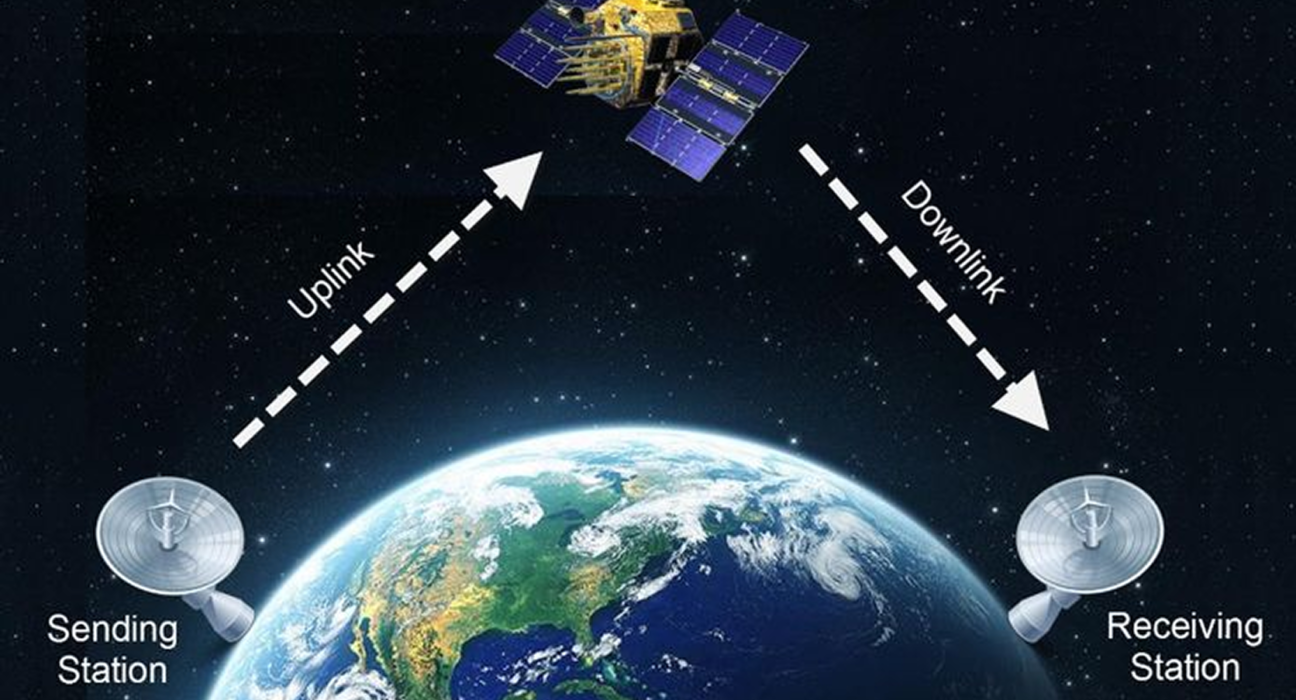
Communication generally involves radio signals traveling between the satellite and ground stations.
A simplified communication process looks like this:
Ground station → satellite → ground station or user
For example, a ground station may send a command to a satellite.
The satellite receives the signal, processes it and performs the requested operation.
The satellite can then send information back to Earth.
Different satellite systems use different frequencies, antennas and communication technologies.
How Does GPS Use Satellites?
GPS relies on a constellation of navigation satellites.
These satellites continuously transmit timing information.
A compatible receiver, such as a smartphone or navigation device, receives signals from multiple satellites.
By comparing the timing of those signals, the receiver can estimate its position.
This basic principle allows devices to determine where they are on Earth.
Modern positioning systems can combine satellite signals with other technologies to improve accuracy and reliability.
How Do Weather Satellites Work?
Weather satellites observe Earth’s atmosphere and surface from space.
They can collect information about:
- Clouds
- Storm systems
- Temperature
- Moisture
- Atmospheric conditions
- Ocean and land surfaces
This information is sent to Earth, where meteorologists and forecasting systems use it alongside other observations.
Weather satellites are particularly valuable because they provide a large-scale view of atmospheric systems.
How Do Earth-Observation Satellites Work?
Earth-observation satellites collect information about the planet using cameras and other sensors.
Depending on the instrument, they can observe:
- Forests
- Agriculture
- Oceans
- Ice
- Cities
- Roads
- Natural disasters
- Environmental changes
Some sensors can detect wavelengths of light that human eyes cannot see.
This allows scientists and organizations to gather information that would be difficult to obtain from the ground.
How Do Satellites Take Pictures?
Imaging satellites use specialized sensors to capture information about Earth’s surface.
The sensor detects electromagnetic radiation reflected or emitted by objects.
The collected information is converted into digital data.
That data is transmitted to Earth and processed into images or other forms of information.
Satellite imagery can be used for mapping, environmental monitoring, scientific research and many other applications.
What Happens When a Satellite Stops Working?
Satellites do not operate forever.
A satellite may eventually run out of fuel, experience equipment failures or reach the end of its planned mission.
What happens afterward depends on its orbit and mission design.
Some satellites in lower orbits can eventually experience atmospheric drag and re-enter Earth’s atmosphere.
Others may be moved into different orbits designed for long-term disposal.
Spacecraft operators carefully plan these processes to reduce risks and manage the growing population of objects in space.
What Is Space Debris?
Space debris refers to human-made objects in orbit that are no longer functioning or useful.
Examples include:
- Old satellites
- Rocket components
- Fragments from spacecraft
- Other discarded objects
Space debris is a growing concern because objects in orbit can travel at extremely high speeds.
Even relatively small pieces can damage operational spacecraft.
This is why responsible satellite operations and debris-management strategies are increasingly important.
Why Are Satellites Important?
Modern society depends on satellite technology in many ways.
Navigation
Satellites support positioning and navigation services used by vehicles, smartphones and other systems.
Communication
Satellites can connect people and organizations across large geographic areas.
Weather
Weather satellites provide valuable observations for forecasting and storm monitoring.
Science
Satellites allow scientists to study Earth, the Sun, distant planets and the broader universe.
Agriculture
Satellite observations can help monitor crops, land conditions and environmental changes.
Disaster Management
Satellite data can help organizations monitor floods, fires, storms and other natural disasters.
Can Satellites Provide Internet?
Yes.
Some satellite systems are designed specifically to provide internet connectivity.
Satellites can transmit data between users and ground infrastructure.
Modern satellite internet systems increasingly use large groups of satellites in lower Earth orbits.
Because these satellites are closer to Earth than traditional geostationary communication satellites, some systems can reduce communication delays.
However, performance depends on factors such as network design, location, weather and available infrastructure.
Why Are There So Many Satellites?
The demand for satellite services has increased significantly.
Modern satellite networks support:
- Internet
- Navigation
- Communications
- Earth observation
- Scientific research
- Commercial services
Advances in spacecraft manufacturing and launch technology have also made it possible to deploy satellites more efficiently than in earlier decades.
How Are Satellites Launched?
Satellites are carried into space using rockets.
The rocket provides the enormous amount of energy required to overcome Earth’s gravity and place the spacecraft into its intended trajectory.
Once the satellite reaches the appropriate location, it can separate from the launch vehicle and begin its mission.
Some satellites use their own propulsion systems to adjust or maintain their orbit after deployment.
Can Satellites Move?
Yes.
Satellites can use propulsion systems to change their orbit or orientation.
They may need to:
- Adjust their position
- Correct their orbit
- Avoid potential collisions
- Maintain a specific orbital location
- Change orientation
The amount of fuel available for these maneuvers can influence how long a satellite can remain operational.
The Future of Satellite Technology
Satellite technology continues to develop.
Future systems are expected to focus on areas such as:
- Faster communication
- Improved Earth observation
- More efficient spacecraft
- Better navigation
- Scientific exploration
- Space-based infrastructure
- Improved debris management
Smaller satellites are also becoming increasingly important because they can provide useful capabilities while potentially reducing development and launch costs.
Final Thoughts
Satellites may be thousands of kilometers away, but they are closely connected to everyday life.
They help us navigate, communicate, monitor weather, study Earth and explore space.
At the heart of satellite technology is a relatively simple idea: a spacecraft uses its motion and Earth’s gravity to remain in orbit while specialized systems allow it to perform useful work.
As technology advances, satellites will continue to play an important role in how we communicate, understand our planet and explore the universe.
General Information Disclaimer: This article is intended for general educational purposes. Satellite systems, orbital mechanics and communication technologies can be considerably more complex than the simplified explanations provided here.